Click on any of the images below for a larger view.
The River Test |
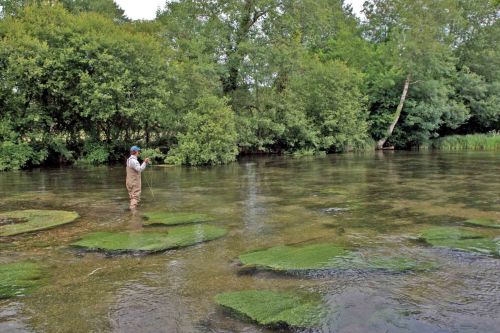
River Dever |
Where bright waters' meet. |
smoke on the water |
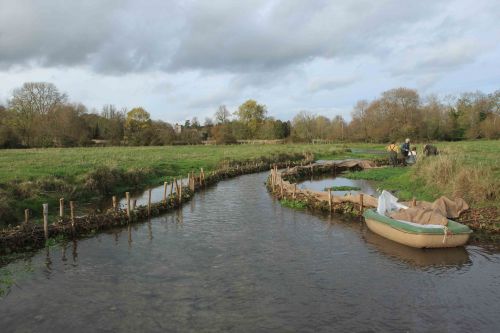
The Leckford eel pots hut - a cold December morning |
The Test, Itchen and Hampshire Avon are the world's most famous flyfishing rivers. Their crystal clear waters flow through the bands of subsurface chalk that run across southern England producing the internationally rare and unique phenomena – the CHALKSTREAM.
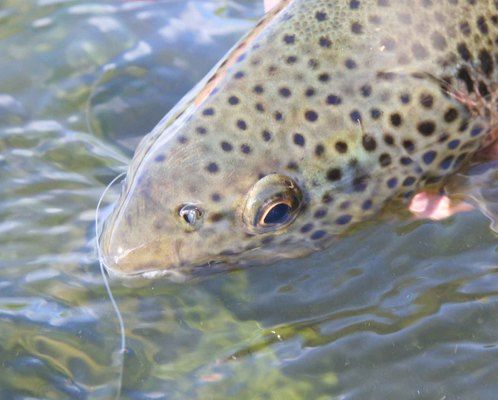
As the rainwater soaks down slowly through the porous chalk geology under gravity, it is filtered and stored in these aquifers. The water eventually emerges from the aquifers as a spring at the source, feeding the river system with very high quality water of a consistent temperature in both summer and winter. The alkaline water that flows in these chalkstream ecosystems is extremely fertile giving rise to an abundance of weed, invertebrates and of course salmon, trout and grayling. These calcium rich waters allow freshwater shrimps, snails and other creatures to build external skeletons. With over half a dozen species of stonefly, twenty two species of mayfly, and nearly forty species of caddis, it is no wonder that these diverse rivers are justifiably famous to the dryfly fisherman.
Chalkstreams only occur in our British Isles, France and New Zealand. Here in southern England these rivers reflect major human intervention over the years. The Romans used the rivers to great effect, particularly to power their mills. In later years an intricate system of carriers and millstreams were dug out criss-crossing the floodplain. These redirected water to drive mills and flood farmland and meadows, thus enriching the land and giving early season grazing - the relatively warm water allowed meadow growth even in the coldest winters. Most of these backwaters can be seen today away from the main river channels. They actually provide some of the most testing and exciting fishing.
The rivers today are privately owned by various ‘riparian’ estates and carefully managed by the estate’s riverkeepers. The riverkeepers maintain the river in optimum condition for flyfishing; cutting weed, mowing banks and boosting the natural fish stocks with stocking programs. We are proud to offer flyfishing on some of the most exclusive estate beats these beautiful chalkstreams have to offer.
THE TEST
The majestic river Test has four main tributaries; the Bourne Rivulet, the Dever, the Anton and the Dun. The large Test floodplain drains an area of 1260 square kilometres. She flows in length for just under 40 miles (64km) from her source in the upper chalk at the village of Ashe, through Whitchurch, Longparish, Chilbolton, then past the Peat Spade at Longstock, down to Stockbridge, Kings Somborne, Romsey, Testwood and through tidal marsh into the estuary at Southampton Water. Her water is so pure it is used to wash the paper that makes the Sterling bank notes for the Bank of England at Portals Mill near Overton.
If one adds all the backwaters and carriers, often running parallel to the main river giving the Test her braided appearance, her total length adds to over 86 miles (139km), giving plenty of water on which to practice this most noble of sports – flyfishing.
The river Test is the birthplace of this sport in the modern sense; the famous Houghton Club in Stockbridge can date back its records to 1822 and every year thereafter. Great fishers and entomologists such as Halford and Lunn started their work on this great river, particularly in this area. This was the precursor to today’s flyfishing techniques – in particular the tying of dry flies and the upstream method of fishing.
The Test is also known for its prolific mayfly hatches - as the name suggests in May (and early June). The mayflies hatch, following two years in their aquatic nymphal stage. The nymphs swim upwards and struggle out of their skins, through the surface film, to emerge as a flying adult - the dun (or sub-imago). If they have been lucky enough to avoid the teeth of hungry trout, they fly to the trees, shed their skin again and the final adult stage of their life cycle is born, the spinner or imago. They hatch, mate, lay their eggs and die – all within a day – hence their name – Ephemera danica ‘the ephemeral dancer’ Anyone who has witnessed clouds of ‘dancing’ male spinners in the trees attracting their mates, knows what a sight it is to see the fall of spent mayfly once they have finished their reproductive duties. The trout go into a feeding frenzy, taking full advantage of this nutritious bounty and packing on their body weight after a more frugal winter. These two weeks are sometimes known as ‘duffers’ fortnight’ because the fishing can be so easy. However, it is also the time when the very large trout can be tempted to the surface from deeper lies to be taken on a traditional upstream dryfly.
THE ITCHEN
With Winchester at its heart, this chalkstream is the Test’s smaller sister. She flows through some of the most beautiful countryside England has to offer. The Itchen stretches for 28 miles (45km) and includes its three tributaries that unite from three separate points of the compass - the Cheriton Stream, the Candover Stream and the River Alre (or Arle). The Itchen’s total catchment is about 400 square kilometres.
Her source is at New Cheriton, she flows near Alresford, on to Itchen Abbas and Kings Worthy. The Romans built a route around the city walls of Winchester, on through Twyford, Eastleigh and out into Southampton Water via Swaythling. Her route is also ‘braided’ with many feeder and carrier streams, weirs and sluices. At her estuary she flows through the ancient city of Southampton and the original docks, home to ocean liners from the Titanic to the Queen Mary II.
As with the Test, the Itchen is regarded as one of the finest chalkstreams in the world. Her pristine waters are still used today to grow watercress. She is home to many rare and beautiful animals such as the otter and the tiny brook lamprey. The Itchen has equally diverse insect life and her impressive mayfly hatches tend to start slightly earlier that the Test. Mayfly can be seen as early as late April, although the fish do not tend to rise to them until there are significant numbers over the water.
This river has also seen its share of famous flyfishing pioneers. Skues spent many hours on the well known Abbots Barton beat perfecting his nymph fishing - fishers still use his books as a reference today. Isaac Walton was another famous fisherman. He wrote one of the most published English books of all time – “The Complete Angler”, and is buried at Winchester Cathedral where a stained glass window pays tribute to the most famous ‘brother of the angle’.
THE AVON
The westerly cousin of the aforementioned rivers is also longer and has a greater watershed. It is one of the country’s most varied rivers. Salisbury is almost a halfway marker and above here features some of our finest wild brown trout and grayling fishing, consisting of gin clear water and again some beautiful and challenging side streams and carriers.
Below the city of Salisbury, the Avon changes considerably; her four tributary chalkstreams being a big factor here. They are the Wylye, the Nadder, the Bourne and the Ebble. The piscatorial quarry changes somewhat as well, coarse fish and salmon are in greater numbers downstream of the city, and the trout that do exist here seem not to rise so freely to the fly.
The Upper Avon starts with two streams, one flowing southwest from Milton Lilbourne, Pewsey and the other southeast from Bishops Canning. These meet just near Upavon, close to the A342. From here this most majestic river winds her way south reaching Netheravon. She passes near to Stone Henge and into the ancient city of Salisbury. Below Salisbury the Nadder, Wylyle and the Bourne converge. Here she changes appearance and with the increased flow becomes wider and deeper, hence the coarse and salmon fishing takes over here. Still flowing very much south she passes Downton, Fordingbridge, Ringwood and through the famous Royalty fishery, along the grounds of Christchurch Priory to flow out into her estuary in Christchurch Bay.
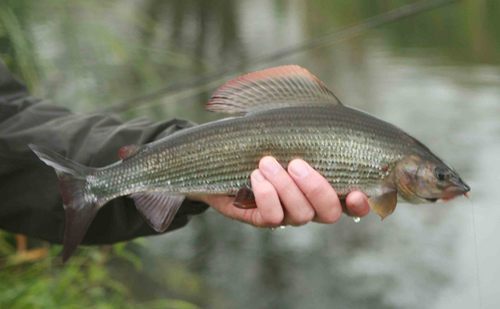
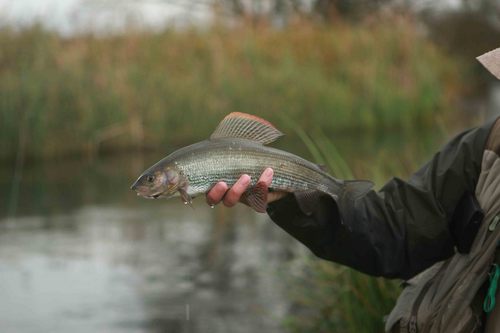
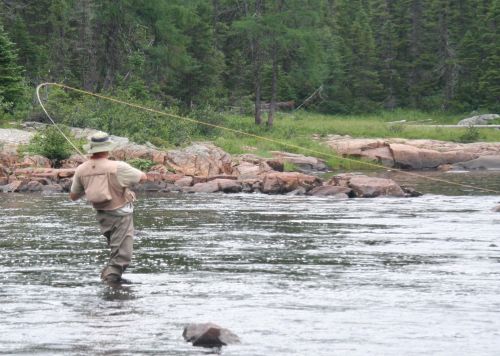
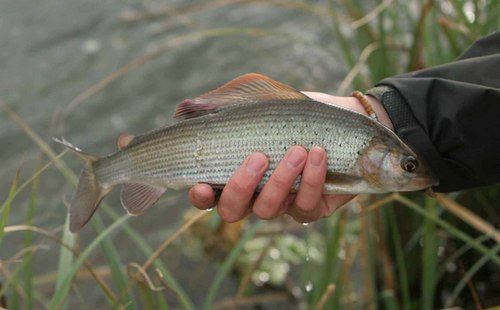
Her upper reaches are of particular interest to the dryfly fisherman. The upper Avon in particular enjoys good hatches of upwing flies, olives and iron blues in early season, alongside hatches of terrestrials such as hawthorn flies which hatch out of the trees to be haphazardly blown onto the water. Trout love Hawthorns and the fishing can often equal that of mayfly time. The upper Avon mayfly occur generally in Mid May, and can last up to 3-4 weeks. Sedges will work well June onwards, normally in the evening, as will olives, which you will hopefully see for the remainder of the season. Many of the beats here provide testing fishing for wild browns and some super grayling to over 3lbs! Chest waders and a wading stick are essential as much of the fishing is from within the river.
It was on these famous upper waters that Frank Sawyer developed his famous style of nymph fishing specifically for grayling. He was the first to tie up artificials with fine copper wire, perfect for light subsurface fishing - this breakthrough gave way to the Grey Goose, the Sawyer’s Pheasant Tail nymph and his Killer Bug, three of our most famous patterns. Oliver Kite was another famous fishing name who spent a lot of time on these waters. A pupil of Sawyer’s, Kite wrote ‘Nymph Fishing in Practice’, a book famous for its study of upstream nymph fishing - this is the style that all of us use today on the English chalkstreams.
SEASON
The trout fishing season for these rivers is from April until October, although riparian owners set specific seasons for their stretch of water. The grayling season follows the trout season in the winter.